Showing posts with label Theme 1 - Ethnic Minorities. Show all posts

Tuesday, August 4, 2009

Article: Xinjiang Unrest - Catalyst for New Grand Vision for China?

Li Mingjiang
21 July 2009

The 5 July Xinjiang incident has its roots in the loopholes of China’s developmental approach. It is obsessed with growth at the expense of social justice and governance, especially at the local levels. The incident should serve as a catalyst for China to seriously contemplate a new grand vision for the country’s future.

THE 5 JULY riots in China’s Xinjiang region marked the most violent ethnic conflict for decades in China. Three stories have emerged as to why an incident of such a scale had taken place. The official Chinese story is that the unrest was fanned and incited by various Uighur groups in exile. The view popular in the West is that the riots occurred largely because of the Chinese government’s disregard for the human rights, culture, traditions and political freedom of local ethnic minority groups. A noticeable voice coming from the Muslim world is that China’s government has badly treated and discriminated against the Muslim communities in the social and economic arenas, inviting revenge from some radical Uighurs. The Turkish government has even used the term ‘genocide’ to characterize the handling of tensions in Xinjiang. All the three stories are partially true. But there is a fourth story, perhaps an even more important one that needs to be told and taken into account. That is, the Xinjiang incident has its deep roots in the loopholes of the Chinese developmental approach: The approach has been too obsessed with growth rates at the expense of social justice and governance, especially at the local levels. The riots should serve as a catalyst for China to seriously contemplate a new grand vision for the country’s future.

Symptom of China’s Problems in Transition

Three questions warrant careful thought before we fully understand the fourth story about the limits of China’s developmental approach. Firstly, why did this tragic unrest happen at a time when China has made so much socio-economic progress after 30 years of reform and opening up? Secondly, why have hundreds and thousands of Han Chinese switched or attempted to switch to minority identities since the late 1980s, if there are institutionalised discriminations against ethnic minorities? What is often glossed over in the aftermath of the incident is the fact that there are many affirmative action programmes in favour of the ethnic minorities. Thirdly, with regard to the official explanation, the question is why these groups in exile were so effective in inciting the unrest as alleged? The deep cause of the riots has to be found in the flaws of China’s developmental strategy. Over the decades, nearly double digit annual growth rates have brought China much wealth.

However, many notable socio-economic problems have also emerged and seem to have intensified in recent years. These negative aspects include the urban-rural divide, widening income gap, scanty social welfare and services, rampant corruption, abuse of power by local governments, and favoritism in the allocation of public resources. Ethnic Uighur minority people, the vast majority of whom live in the rural areas and have far fewer connections (guanxi) to public offices became the victims of the downsides of China’s developmental approach. They face the same experience that millions of the downtrodden Han Chinese have been going through. The negative aspects of China’s development have inflicted so much pain and stress to the numerous people at the social bottom that many of them chose to vent their anger through violence.

According to official figures, there were as many as over 80,000 instances of mass incidents annually in China in the past few years, notable examples being the mass unrest at Weng’an in Guizhou and Shishou in Hubei province. What differentiates the Xinjiang incident from numerous other incidents of mass unrest is the fact that the sufferings of many ethnic minority people are unfortunately linked to ethnic relations. This significantly exacerbated the ethnic tensions that had existed for quite a long time in Xinjiang.

Beijing Should Boldly Tell the Story

The Xinjiang incident has become a rare event that simultaneously pits China against both the developed and much of the developing world. To mitigate external criticisms, China needs to courageously explain to the outside world that this is not purely an ethnic problem, but a problem rooted in China’s socio-economic transition. Telling the story may not completely dispel the misgivings in the West and in the Muslim world. But not doing so will likely put China and its ethnic issues constantly in the spotlight and damage China’s international image and national interests. China faces the risk of its ethnic policy and ethnic relations being completely framed by the West and the opinion leaders in the Muslim world. Many people in China may feel such explanation tarnishes the reputation of the ruling elite and negate the great achievements that China has made. This worry is unnecessary. After all, the economic miracle in China has been acknowledged worldwide. Candour will only win respect from the rest of the world.

Catalyst for a New Grand Vision?

No doubt, China will undertake a comprehensive review of this incident. It would be fortunate if such a review is done in relation to mounting social tensions throughout China in the larger context of China’s development trajectory rather than on the Xinjiang incident alone. The Chinese government’s pro-people policy measures in recent years definitely have helped in mitigating grievances at the grassroots level. But numerous signs show that these programmes are far from sufficient. Popular resentment over abusive governance at the local levels seems to be on the rise. The numbers and destructiveness of social unrests have not decreased in recent years. The sociopolitical structure that disadvantages the social bottom seems to have been further consolidated. The Xinjiang incident should be a wake up call for China. It is time for China’s leaders to courageously develop a new grand vision or China’s future, but what should it be? Many elements in the late leader Deng Xiaoping’s old grand vision seem to have been fulfilled or are now incompatible with the social-economic reality in China. A new grand vision will have to tackle three major issues: social equity, social welfare, and government accountability and responsiveness. These goals may seem too conservative in the eyes of liberal advocates. But hopefully, success in meeting these challenges will lay a good foundation for China’s search for a more sustainable political, social, and economic development model for the future.

Tuesday, July 7, 2009

Article - Ethnic Minority Uyghur Unrest in Urumqi


Han Chinese fight back


Related: Clashes in China Shed Light on Ethnic Divide (July 7 2009)

Related: Han Chinese protesters seek Muslim Uighur targets (Reuters 7 July 2009)

See how the PLA and Armed Police step in to restore peace


Another Media Tour Goes Very, Very Badly for Chinese Authorities (by Robert Mackey from NY Times)

Related link:

Watch a video report on The Guardian’s Web site, showing a powerful image of an elderly Uighur woman on crutches confronting riot police in Urumqi, China on Tuesday.

As my colleague Edward Wong reports from Urumqi, China, where rioting and ethnic clashes have led to more than 150 deaths, a government-organized tour for foreign and Chinese journalists went badly awry on Tuesday when hundreds of Uighur protesters made an unscheduled appearance:

A wailing crowd of women, joined later by scores of Uighur men, marched down a wide avenue Tuesday with raised fists and tearfully demanded that the police release Uighur men who they said had been seized from their homes after Sunday’s violence. Some women waved the identification cards of men who had been detained.

As journalists watched, the demonstrators smashed the windshield of a police car and several police officers drew their pistols before the entire crowd was encircled by officers and paramilitary troops in riot gear.

Dan Chung and Tania Branigan of The Guardian were also on the media tour and they filed a video report and a slide show showing images of the Uighur protests witnessed by the foreign and Chinese press.

As if to underscore how very badly this attempt at media management by the Chinese government failed, the screen shot at the top of this post from The Guardian’s video report — like a similar photograph, also shot by Mr. Chung for The Guardian — is strangely evocative of the iconic image from the Tiananmen Square protests, of a man confronting a row of Chinese tanks.

In today’s New York Times, Michael Wines reports that Chinese officials arranged the tour as part of a broad effort to manage media perceptions of the unrest. Apparently hoping to do more than just shut off the flow of unwelcome images of protests from appearing on the Web, as Iranian authorities did recently, China invited foreign journalists to take part in the official trip to Urumqi, the site of the unrest, “to know better about the riots.” But China’s ethnic minorities have a habit of not remaining placidly in the background during these sorts of state-managed photo-ops.

Today’s events bring to mind a similarly botched effort just over a year ago, as The Times reported: “Buddhist monks interrupted a government-managed news media tour in western China by waving a Tibetan flag and protesting that the authorities were depriving them of their human rights.” Here is video of those Tibetan monks veering as far off-script during that media tour in April, 2008 as the Uighurs did today in Urumqi:

Monday, May 4, 2009

Article - Mongols' 'subsumed' culture

ST 4 May 2009

A bleak future BAIYUNKUANGQU (China) - BAYAR has spent most of his 48 years roaming the great Mongolian steppe in northern China, grazing his sheep flocks as his ethnic Mongol ancestors did for centuries.

But he was forced to settle down three years ago in a small brick house on a windswept plain here due to grazing restrictions which Mongols call the latest harsh blow to their age-old pastoral culture under Chinese rule.

The restrictions, first introduced a decade ago and now being stepped up, are aimed at protecting grasslands from desertification due to excessive farming, the overgrazing of expanding livestock herds and drought.

For centuries, Mongols have grazed sheep, cattle and horses and hunted on the open steppe, camping in circular white tents known as yurts in a rugged, nomadic lifestyle that gave rise to the mobile cavalry of legendary conqueror Genghis Khan.

But those days are over for Bayar. He now ekes out a living renting out fake 'yurts' to vacationing Chinese tourists eager to play nomad for a night.

The government 'encouraged' this, he said, saying no more under the watchful eye of local officials who followed AFP reporters to his remote home in a sign of the issue's sensitivity.

In private, others are less guarded about the grazing restrictions. Bayar now must pen his herds three months of the year. Unable to afford feed for such a long period, he had to sell half his 300 sheep, taking a loss amid plunging mutton prices.

Critics say government compensation is inadequate or non-existent and allege that many of the 'protected' lands were later taken over by Chinese mining and energy firms.

According to China's forestry ministry, expanding deserts threaten up to 400 million people and recently were growing by nearly 3,500 square kilometres a year to now cover a third of the country.

While China is widely accused of cultural repression in Tibet and its Muslim northwest, Mongols say their way of life also is being subsumed by Chinese culture and insensitive policies, as well as the impacts of climate change. -- AFP

Saturday, February 21, 2009

Assignment: Who Are The Chinese?

Central Question: Is there such a thing as a common Chinese identity/ society?

Some Guiding Questions:
  • What are some criteria for defining identity/society?
  • How important is a particular factor, e.g. language, in determining the unity or diversity of Chinese society? Why is this so?
  • Has the significance of the factor increased or decreased over time? What are the reasons for this development?
Resources
CHINA: Portrait of a People


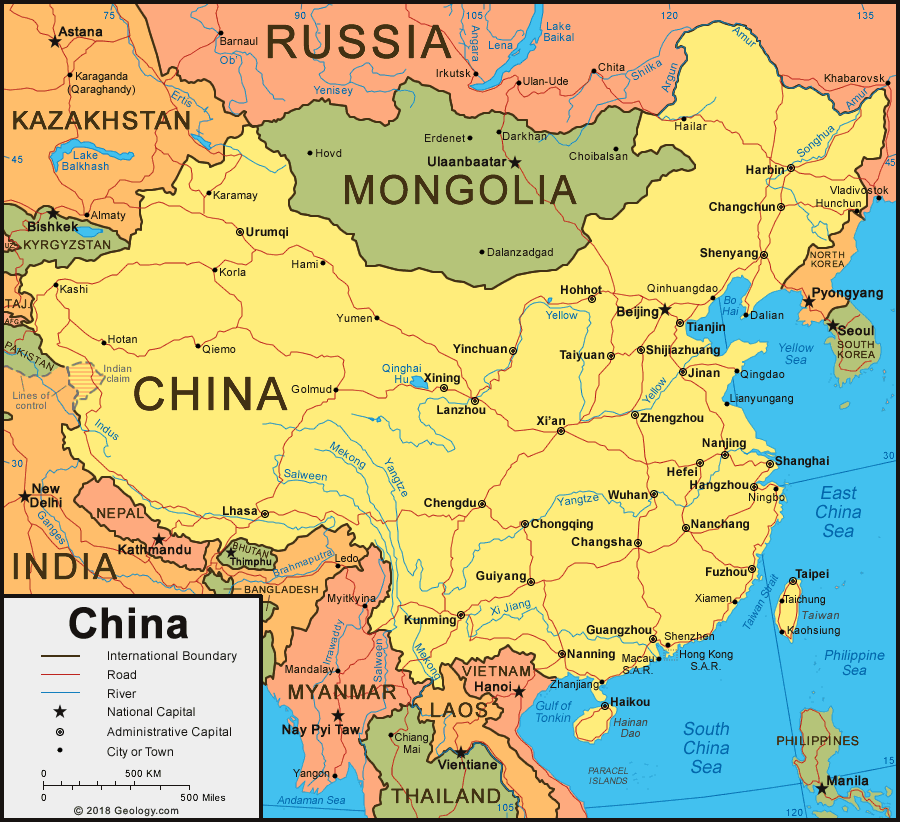
Observe carefully how the faces, culture (dressing, art and festivals), occupations, etc differ among the people from the 22 Provinces (省 shěng) , 5 Autonomous Regions (自治区 zìzhìqū), 4 Municipalities (直辖市 zhíxiáshì) and 2 Special Administrative Regions (SARs - 特别行政区 tèbié xíngzhèngqū) - see map of province-level divisions

Hui Muslim community from China

Consider how the Hui Muslims in China fit (or not fit) into your idea of "Who are the Chinese"?

Extension
A website suggests that, among others, “Chinese” can possibly be defined on the basis of race and blood. Put loosely, all of the descendants of Yan and Yellow Emperors, all of the heirs of the dragon are Chinese. Just like this below song 龙的传人 (Heir of the Dragon) goes, “always an heir of the dragon“ as long as you have "black eyes, black hair and yellow skin"...


Click here for the (US born and raised) Wang Leehom's version of the song (see lyrics in English and Chinese)

If we talk a little more tightly, if your bloodlines are 100% Chinese, then using this definition, you are Chinese, and this will never change. It doesn’t matter what passport you hold, it doesn’t matter what citizenship you hold, even if you grow up or are born in a different country and can’t speak Chinese, you’re still Chinese.

What do you think? How important is bloodline in determining "Who is Chinese"? On the other hand, what about "understanding of China’s language, history, and culture.... of China’s way of life"?

Thursday, February 19, 2009

Article - 'Say no to separatism'

Straits Times Feb 19, 2009

BEIJING - TIBET'S official Buddhist association called on lamas and nuns to reject the Dalai Lama and separatist activities as China braces for possible further unrest ahead of politically sensitive anniversaries.

March marks the first anniversary of protests and deadly riots in the regional capital, Lhasa, and the 50th anniversary of the Dalai Lama's flight into exile after a failed uprising against Chinese rule.

China's Communist Party has ruled Tibet with an iron fist since People's Liberation Army troops marched into the mountainous region in 1950 and brands the exiled Dalai Lama a 'splittist'. The Dalai Lama says he only wants more autonomy for the region.

Tibet's government-sanctioned Buddhist association (as all religious organisations in China are) had 'unanimously endorsed' (notice the quotation marks!) a revision to their constitution calling on local nuns and monks to reject the Dalai Lama and separatist activities at their annual congress this week, Xinhua news agency said on Thursday.

Monks and nuns should 'safeguard social stability, the socialist legal system and fundamental interests of the people", and should 'consciously keep themselves away' from separatist activities and illegal demonstrations that impair social order, Xinhua quoted the new constitution as saying.

It urged monks to 'see clearly that the 14th Dalai Lama is the ringleader of the separatist political association which seeks 'Tibet independence', a loyal tool of anti-China Western forces, the very root that causes social unrest in Tibet and the biggest obstacle for Tibetan Buddhism to build up its order', the agency said.

The Tibetan government's religious affairs committee had also awarded 36 monks and nuns and 10 monasteries with the title of 'patriotic and law-abiding' models, Xinhua said.

Nearly a year after the Lhasa riots fanned protest and violence in other ethnic Tibetan areas of China, killing at least 19 people, China has cautiously opened up monasteries to the devout.

But security remains tight and monks must attend patriotic education classes, (Note this second instance of religion being tightly controlled by the state) along with their Buddhist scripture studies.

Analysts outside of Tibet say an extensive crackdown, including fresh arrests, should make a repeat of last year's unrest unlikely, but local officials are not ruling it out.

Authorities detained 24 people for marching and shouting support for the Dalai Lama in Lithang, an ethnic Tibetan region of southwest Sichuan province, an overseas rights group said this week.

Local police denied any knowledge. -- REUTERS

Related sites:
Related video: March 2008 Tibetan Protest in Lhasa


Questions
  1. Why do some Tibetans pursue "greater autonomy" for Tibet? (Consider the issue of Chinese identity)
  2. In view of the above articles and your own research, what are the challenges faced by the Chinese Communist Party (CCP) in its governance of China and what measures have they adopted to deal with the problems?